Can Customers Book Tables Online? How Modern UK Restaurants Are Increasing Reservations
If you’re still managing reservations over the phone or using a paper diary, you’re likely spending unnecessary time on bookings…
Read More → +44 7936 3880 58

+44 7936 3880 58
+44 7936 3880 58
For modern restaurants, cafés, pubs and hospitality businesses, customer expectations are changing. Diners increasingly want faster service, convenient ordering and greater control over their dining experience. A QR code ordering system can help restaurants meet these expectations by making the ordering process quicker, simpler and more efficient.
Instead of waiting for a server to take an order, customers can scan a QR code for ordering placed on their table, browse the digital menu, customise their selections and submit an order directly from their smartphone.
But does QR ordering really improve customer service?
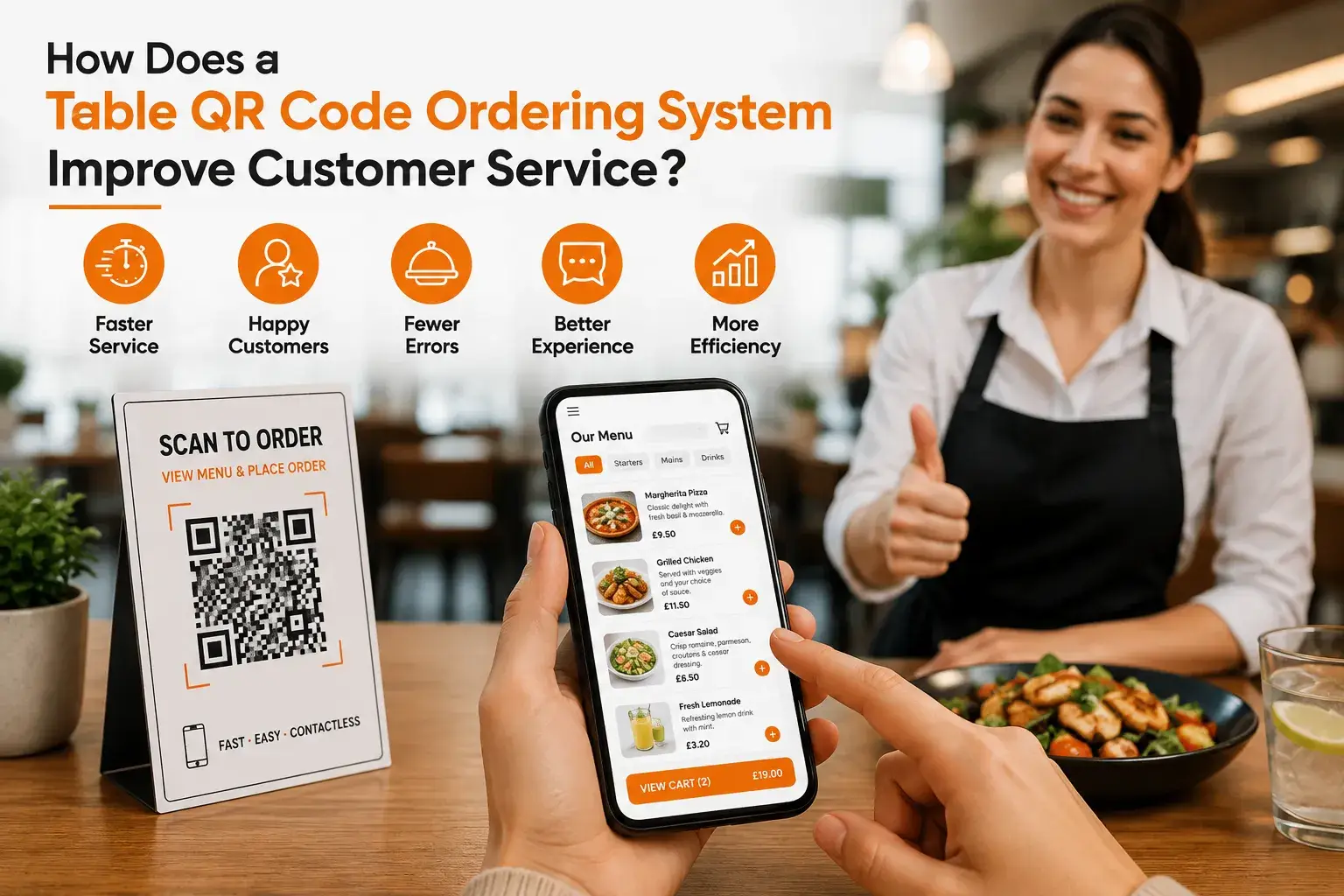
Yes. A well-designed QR code based ordering system can reduce waiting times, minimise ordering errors, improve staff responsiveness and give customers a more convenient way to order.
A table QR code ordering system allows customers to access a restaurant’s digital menu by scanning a unique QR code using their smartphone.
Once scanned, the customer can view menu items, descriptions, prices and available options. Depending on the restaurant’s setup, they can then place an order for food and drinks directly from their table.
A typical food ordering system using QR code technology works like this:
This creates a more streamlined ordering system with QR code, reducing unnecessary steps between the customer and the kitchen.
Customer service is not only about how friendly staff are. It is also about how quickly, accurately and conveniently customers can interact with a restaurant.
A QR code based food ordering system can improve that experience in several important ways.
One of the biggest frustrations for restaurant customers is waiting to place an order.
During busy periods, staff may be serving multiple tables simultaneously. Customers might have to wait several minutes before someone is available to take their order.
With qr code menu ordering, customers can start browsing the menu as soon as they sit down.
They don’t need to wait for a server to bring a physical menu or take their initial order. This can make the entire dining experience feel faster and more responsive.
Different customers prefer different ways of ordering.
Some want to ask a server questions, while others prefer browsing the menu independently. A QR code based ordering system gives customers greater control over when and how they order.
They can take their time reviewing menu items, checking prices and selecting options without feeling rushed.
For restaurants, this can create a more relaxed and customer-friendly experience.
Traditional ordering can sometimes result in misunderstandings.
A server may mishear an item, enter the wrong quantity or miss a customer’s special request. These mistakes can lead to delays and negatively affect customer satisfaction.
A qr code for ordering allows customers to submit their selections directly through the digital menu.
When the system is properly integrated with restaurant operations, the order can be sent directly to the relevant workflow, reducing the number of manual steps involved.
Fewer ordering errors can mean fewer complaints, fewer remakes and a smoother experience for both customers and staff.
A digital menu can provide considerably more information than a traditional printed menu.
Restaurants can include:
This makes qr code menu ordering more informative and convenient.
Customers can make decisions based on the information available to them rather than having to repeatedly ask staff about basic menu details.
A QR ordering system does not necessarily replace restaurant staff. Instead, it can help them spend more time on tasks where human interaction adds the most value.
When customers can handle routine ordering themselves, staff can focus on:
This can create a better balance between technology and traditional hospitality.
Lunch hours, evenings and weekends can put significant pressure on restaurant teams.
When several tables need attention at the same time, traditional ordering processes can become slow.
A qr code based ordering system allows multiple tables to place orders simultaneously without requiring a member of staff to visit each table before the order can enter the restaurant’s workflow.
This can help restaurants manage peak periods more efficiently while reducing pressure on front-of-house teams.
Convenience is one of the main reasons customers use digital restaurant technology.
With qr code for ordering, customers can place an order directly from their smartphone without waiting for menus, order-taking or repeated staff visits.
For cafés, pubs, casual restaurants and other hospitality businesses, this convenience can become an important part of the overall customer experience.
Yes. A QR code ordering system can complement traditional table service rather than completely replacing it.
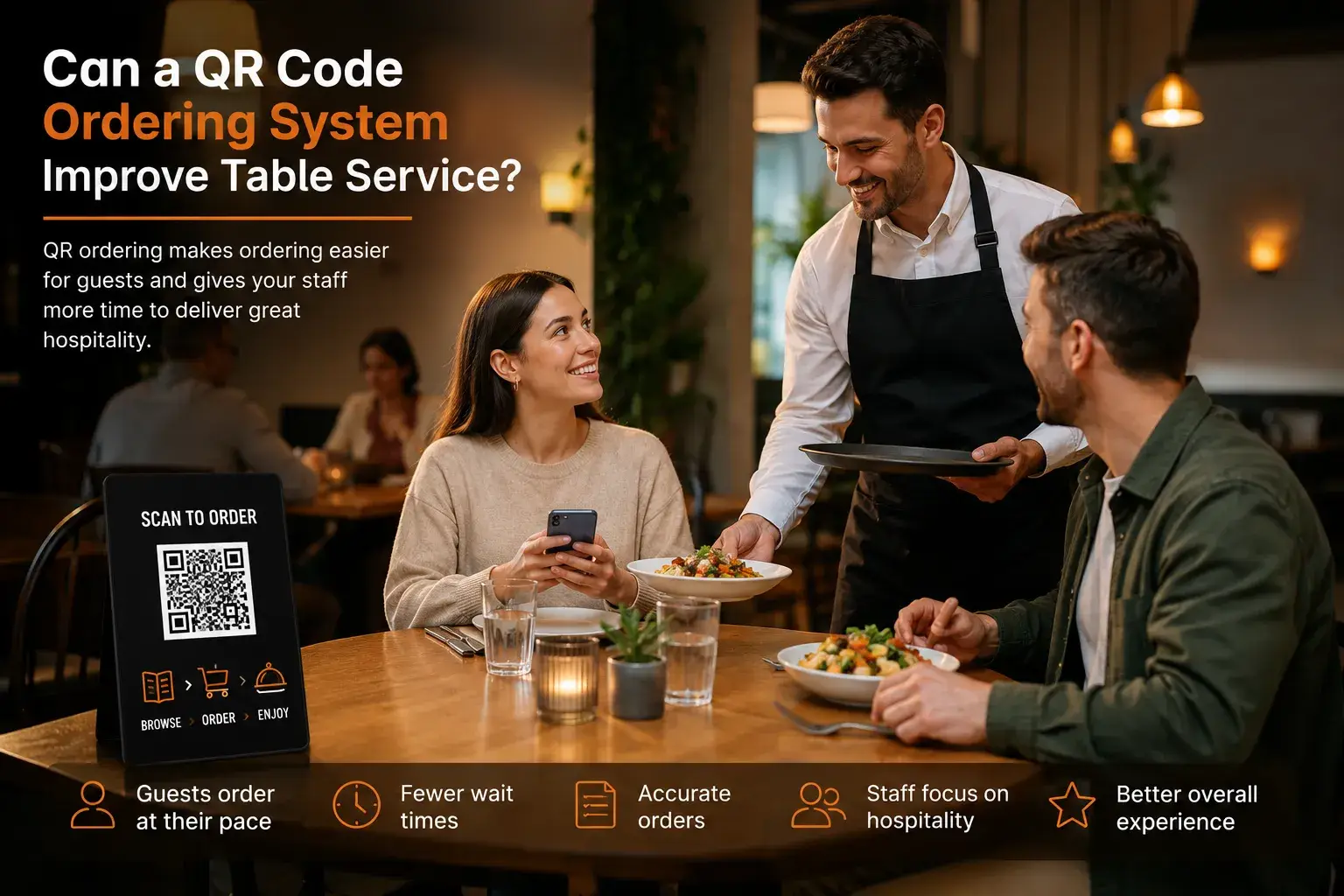
For example, customers could use the QR code to order their initial food and drinks while staff continue to provide personal service throughout the meal.
Customers may also be able to use the system to order additional drinks, desserts or side dishes without waiting for a server.
This creates a hybrid service model:
Digital ordering + human hospitality = a more flexible dining experience.
The technology handles repetitive ordering tasks while restaurant employees remain available for personal interactions and service.
QR ordering can be particularly useful in high-volume environments such as cafés, cafeterias, food courts and canteens.
A cafeteria food ordering system using QR code technology can allow customers to browse available items and submit orders from their phones.
This can potentially reduce queues and make ordering more organized during busy periods.
For example, a customer could scan a QR code, select their meal, submit the order and then collect it when it is ready, depending on the restaurant’s chosen workflow.
The same concept can be adapted for different hospitality environments.
| Feature | Traditional Ordering | QR Code Ordering |
| Menu access | Printed menu | Digital menu |
| Waiting to order | Often required | Customers can order independently |
| Order entry | Usually manual | Digital |
| Menu updates | Requires reprinting | Can be updated digitally |
| Customisation | Staff-dependent | Can be selected digitally |
| Peak-time ordering | Staff capacity dependent | Multiple customers can order simultaneously |
| Additional orders | Customer may need staff assistance | Can potentially order digitally |
| Menu information | Limited by print space | Can provide richer information |
The best approach depends on the restaurant. QR ordering does not have to eliminate personal service. Instead, it can remove unnecessary friction from the ordering process.
Not every QR ordering solution offers the same capabilities.
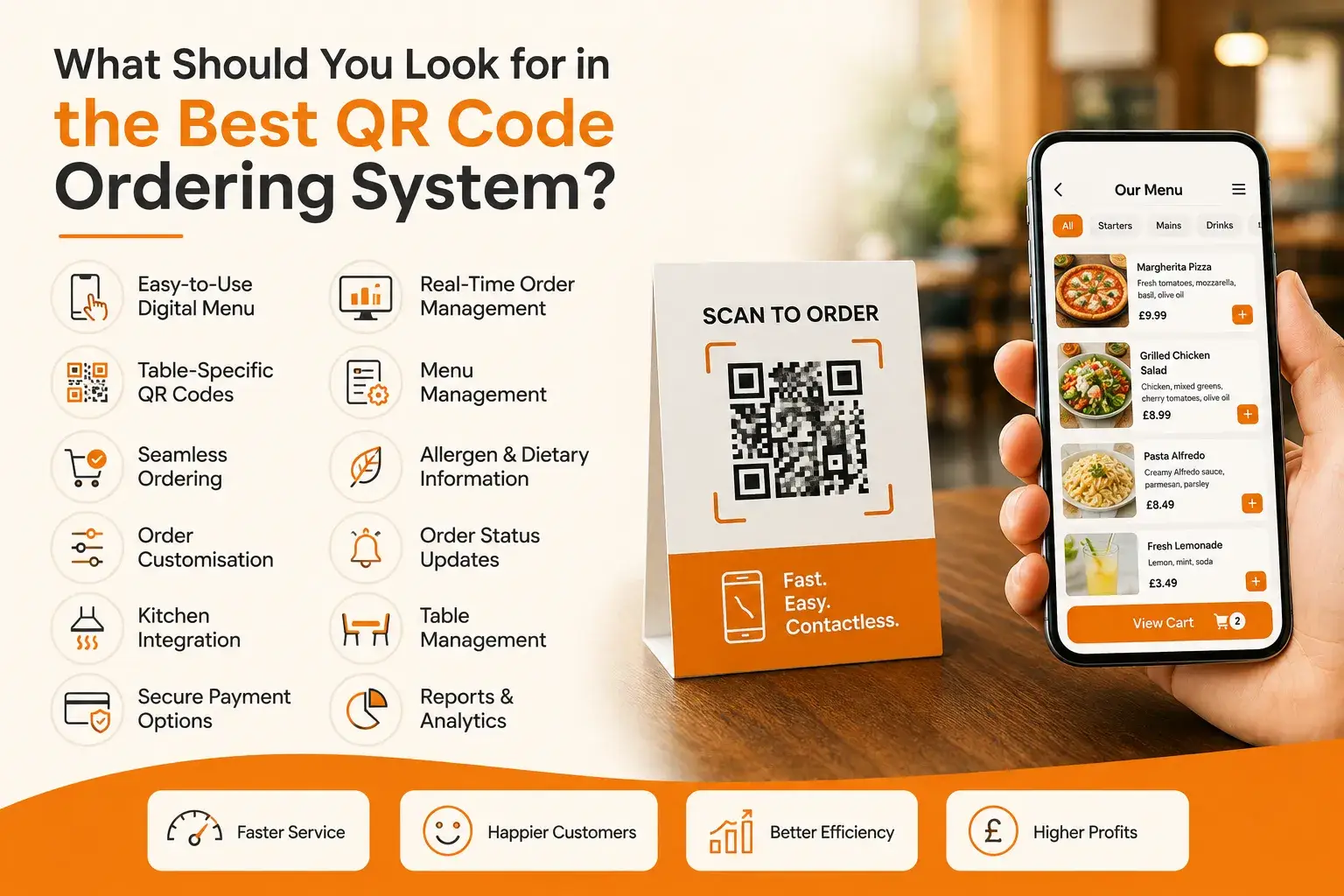
When choosing the best QR code ordering system for your restaurant, look for a platform that provides more than simply displaying a digital menu.
Important features may include:
Most importantly, the system should fit naturally into your restaurant’s existing operations.
A QR code should make ordering easier—not introduce another complicated process for staff or customers.
QR technology can be used for more than food ordering.
Restaurants can also use QR codes to direct customers towards booking or reservation functionality. A qr code booking system can provide a convenient way for customers to access a restaurant’s booking page from printed materials, tables, promotional displays or other physical touch points.
This creates another digital connection between the customer and restaurant.
For example:
Scan → View information → Book a table → Receive confirmation
The exact functionality depends on the restaurant platform being used.
TableReady is designed to help modern UK restaurants simplify ordering and restaurant operations through connected digital tools.
TableReady’s Table QR Code Ordering System allows restaurants to provide customers with a convenient way to access their menu and order directly from their table.
Combined with features such as online ordering, order management, kitchen operations and table management, the platform can help restaurants create a more connected customer journey.
The goal is simple: make ordering easier for customers while helping restaurant teams work more efficiently.
A QR code ordering system can do more than replace a printed menu. When properly implemented, it can make the customer journey faster, more convenient and more flexible.
Customers can access the menu instantly, place orders at their convenience and potentially reduce the time spent waiting for staff. At the same time, restaurant teams can spend more time delivering personal hospitality rather than managing repetitive manual ordering tasks.
For modern UK restaurants looking to improve service without compromising the human side of hospitality, a qr code based ordering system can be a practical addition to their technology stack.
The key is choosing a system that connects QR ordering with the wider restaurant operation—not simply a QR code that displays a menu.
Ready to make table ordering simpler? Explore TableReady’s complete restaurant platform and see how QR ordering can fit into your restaurant’s operations.
What is a QR code ordering system?
A QR code ordering system allows customers to scan a QR code using their smartphone to access a digital restaurant menu and place an order. Depending on the platform, orders can be sent directly into the restaurant’s ordering and kitchen workflow.
How does QR ordering improve customer service?
It can reduce waiting times, make menu access easier, reduce manual ordering steps and give customers more control over the ordering process. Staff can then focus more on hospitality and customer support.
Is QR code ordering suitable for restaurants?
Yes. QR ordering can be used by restaurants, cafés, pubs, takeaways, cafeterias and other hospitality businesses. The right setup depends on the business’s service model and operational requirements.
Can customers customise orders through QR ordering?
Many modern QR ordering platforms allow customers to select modifiers, add-ons and other available options before submitting an order. The exact functionality depends on the system.
Can QR ordering replace restaurant staff?
Not necessarily. QR ordering is best viewed as a tool that can support restaurant staff. It can automate routine ordering tasks while employees continue to provide personal service and hospitality.
Can QR codes be used for restaurant bookings?
Yes. QR codes can direct customers to a restaurant’s booking or reservation page, making it easier for customers to access booking functionality from physical locations and marketing materials.


Thank you for your message. It has been sent.