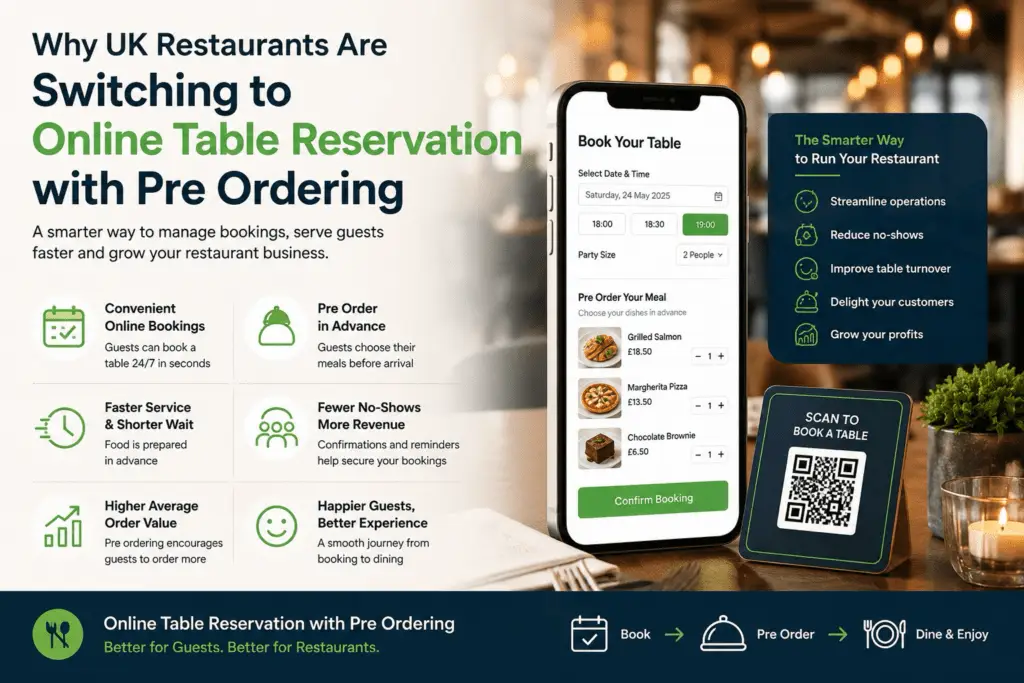
Why UK Restaurants Are Switching to Online Table Reservation with Pre Ordering
UK restaurants are increasingly adopting online table reservation with pre ordering because it improves customer experience, reduces no-shows, speeds up…
Read More → +44 7936 3880 58

+44 7936 3880 58
+44 7936 3880 58
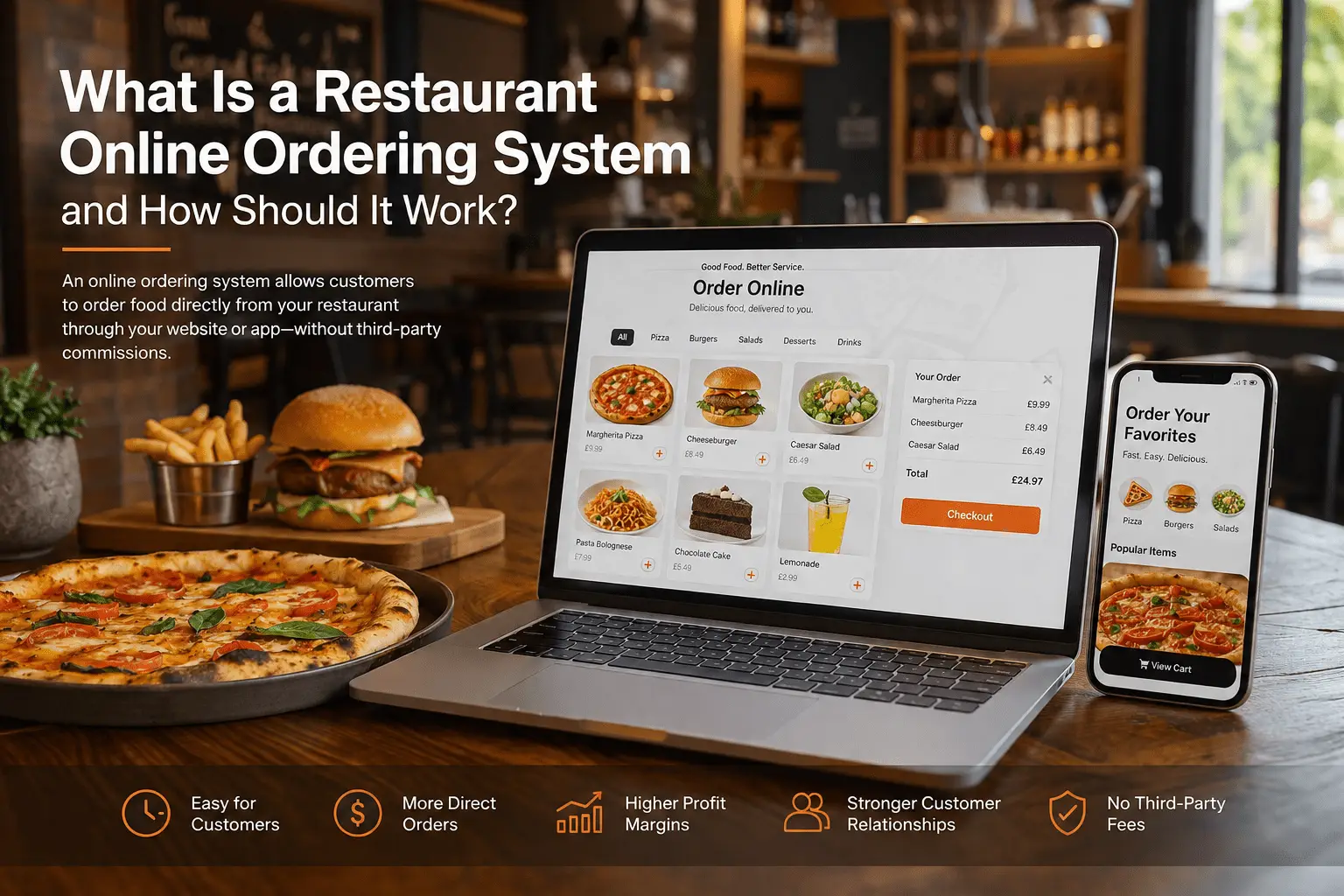
The modern culinary landscape is changing at a breakneck pace. If you walk into a thriving independent bistro, a bustling neighborhood pizzeria, or a popular local café in the UK today, you will notice something distinct: technology is running quietly behind the scenes to keep the operation seamless.
For years, restaurant owners measured success purely by how many bums they could get into seats or how fast the front-of-house team could clear a queue. Today, success is hybrid. It lives both on the dining room floor and in the digital ether.
If your food business is still relying exclusively on phone calls, handwritten takeaway pads, or surrendering 30% of your hard-earned revenue to giant third-party food aggregators, you are playing a rigged game.
Enter the restaurant online ordering system.
In this comprehensive guide, we will break down what an online food ordering system is, how it works under the hood, why relying on third-party marketplaces is quietly draining your profits, and how adopting a dedicated online ordering system for restaurants can transform your profitability.
At its core, a restaurant online ordering system is a digital infrastructure that allows food businesses—ranging from fine dining establishments offering click-and-collect to high-volume takeaways and ghost kitchens—to accept, process, and manage customer orders over the internet.
Unlike a passive website that merely displays a PDF menu, a true restaurant ordering software acts as an active commerce engine. It handles:
When integrated into a broader restaurant ordering platform like TableReady, this technology bridges the gap between hungry customers and kitchen staff, creating a single source of truth for your daily operations.
The hospitality industry has weathered immense economic pressure over recent years. Rising food costs, fluctuating utility bills, and minimum wage adjustments mean that restaurant profit margins—traditionally razor-thin at around 3% to 5%—are under constant threat.
In response, restaurant owners have had to closely examine where their orders come from.
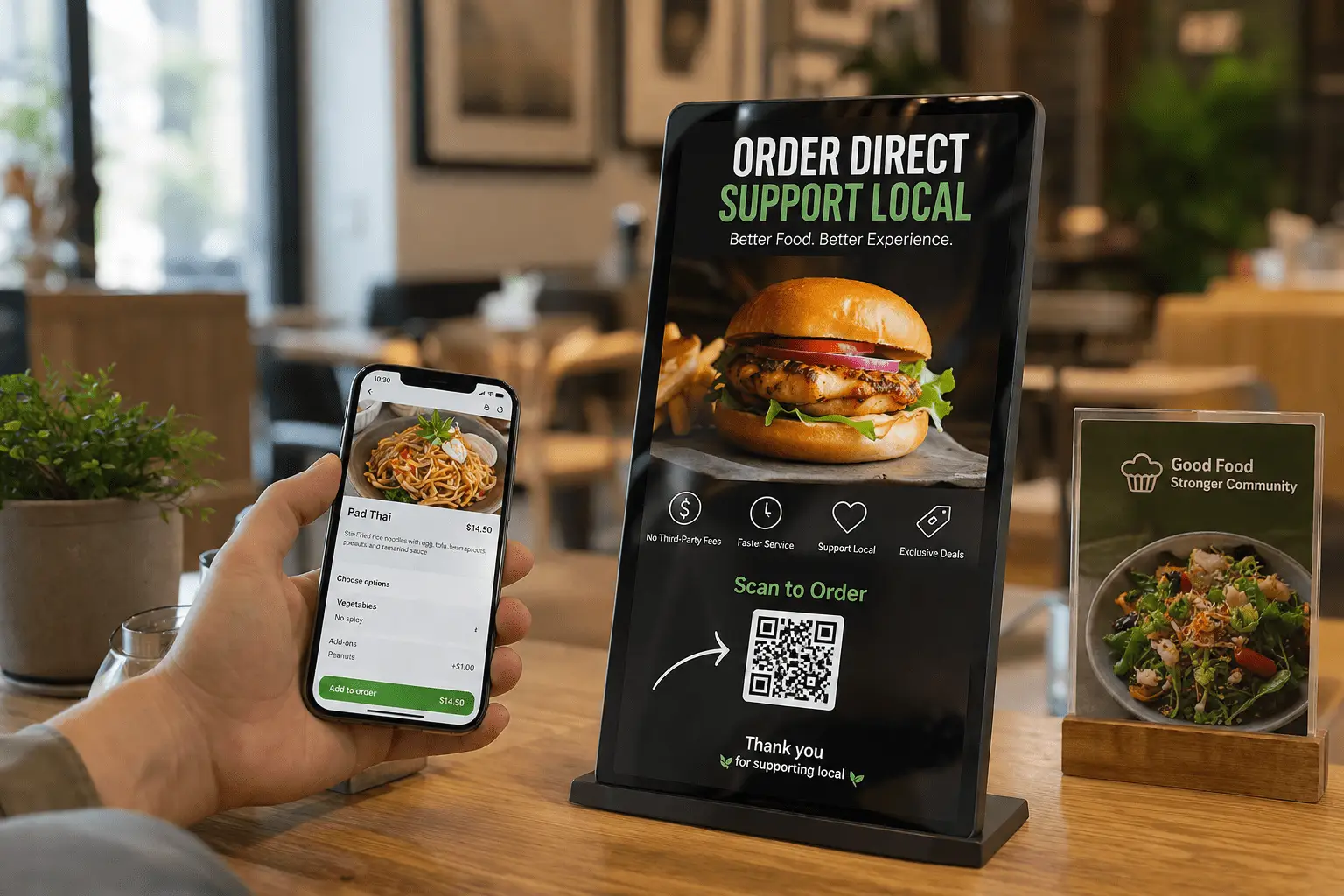
When third-party delivery apps first emerged, they were marketed as a magic bullet for exposure. The pitch was simple: list your menu on our app, and we will bring you new customers.
The reality turned out to be far more expensive:
By implementing a proprietary online ordering system for restaurants, you flip the script. You transform your website from a digital billboard into a 24/7 revenue-generating storefront.
To understand how effortless modern technology has become, let’s look at the customer journey and the back-end workflow.
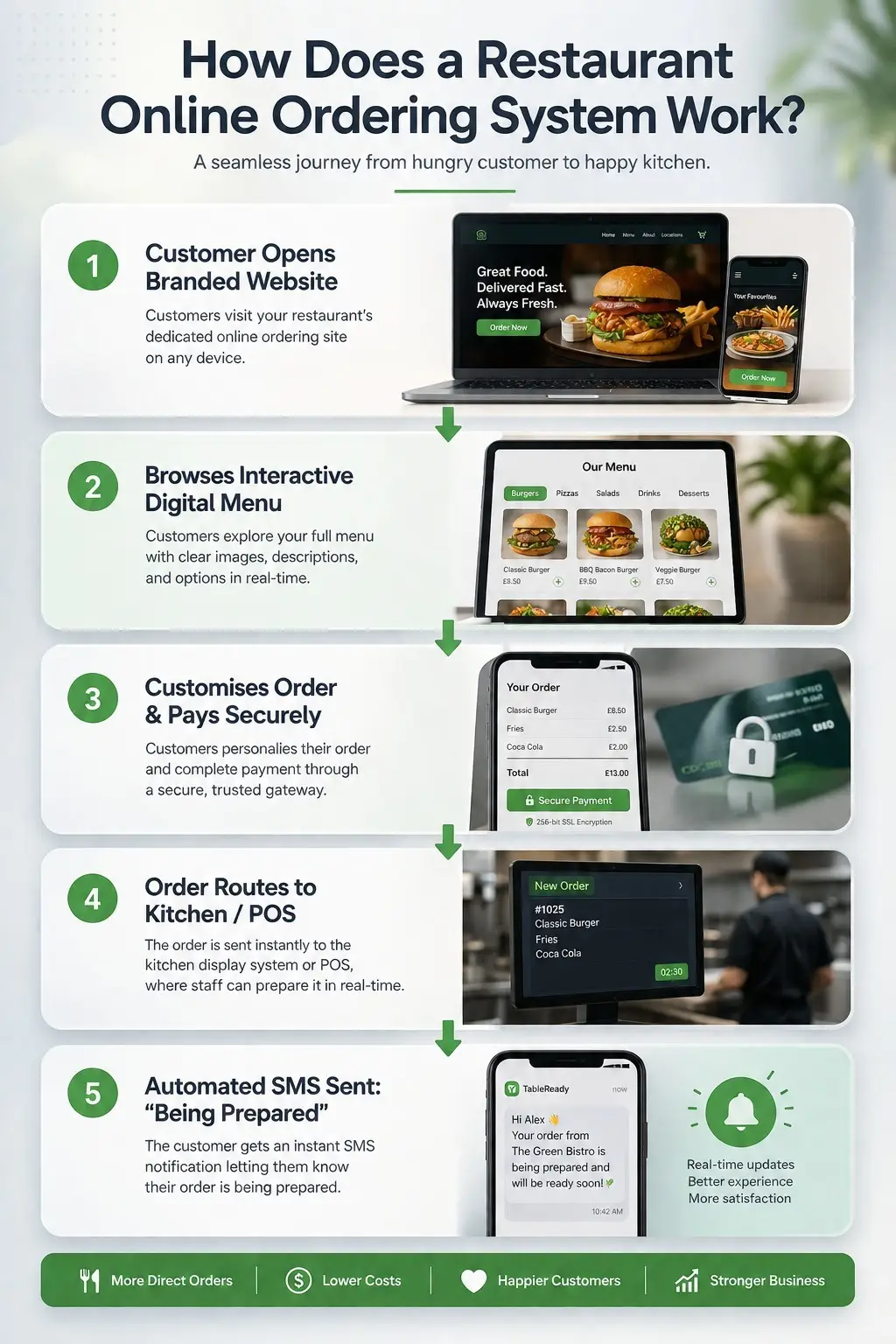
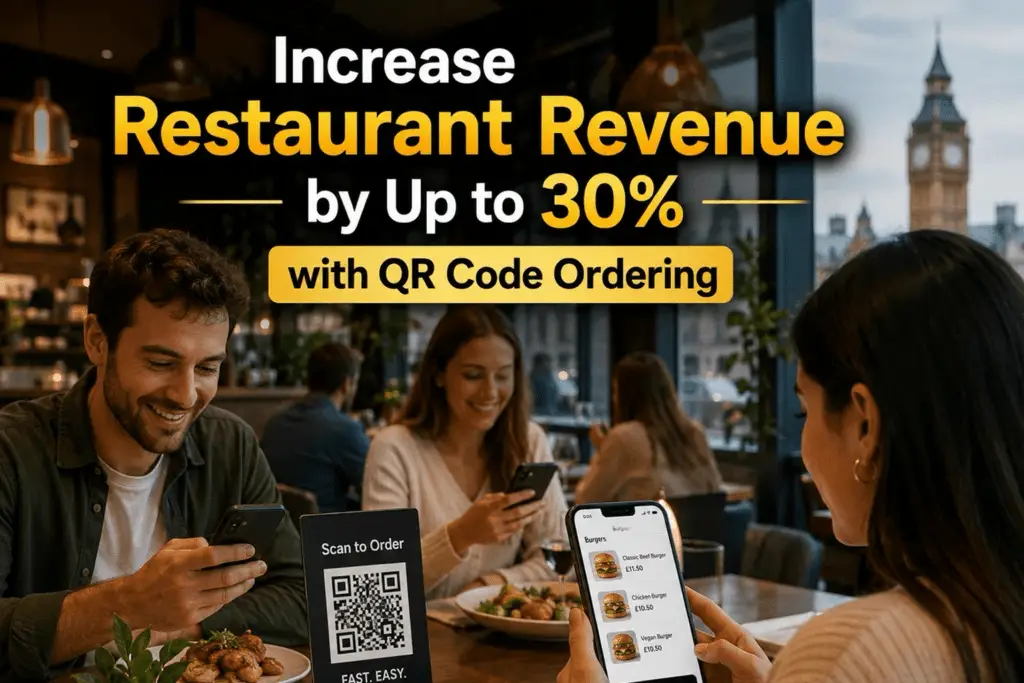
A local resident searches for your restaurant online or scans a QR code on your table or marketing flyer. Instead of landing on a generic aggregator, they land on your fully branded website, optimized for mobile, tablet, and desktop devices.
The customer interacts with a dynamic online menu ordering system. Unlike static PDFs, digital menus allow for rich descriptions, high-resolution photography, and smart upselling prompts (e.g., “Would you like to add loaded fries or an extra dip for £2.50?”). Customers can easily specify dietary requirements, choose modifiers (e.g., medium-rare steak, extra cheese, no onions), and select their fulfillment type: Click & Collect (Pickup) or Delivery.
The customer checks out in seconds using saved payment methods, digital wallets like Apple Pay, or credit cards. The system instantly processes the payment, slashing the risk of fraudulent orders or fake no-show cash drop-offs.
Once the order is placed, it doesn’t require a staff member to transcribe details from a phone call or check a messy fax machine. The order shoots straight through the restaurant ordering software to a Kitchen Display System (KDS) or prints automatically at the kitchen pass.
Concurrently, the system triggers automated communications:
Not all software solutions are created equal. If you are evaluating a food online ordering system for your business, ensure it includes the following non-negotiable features:
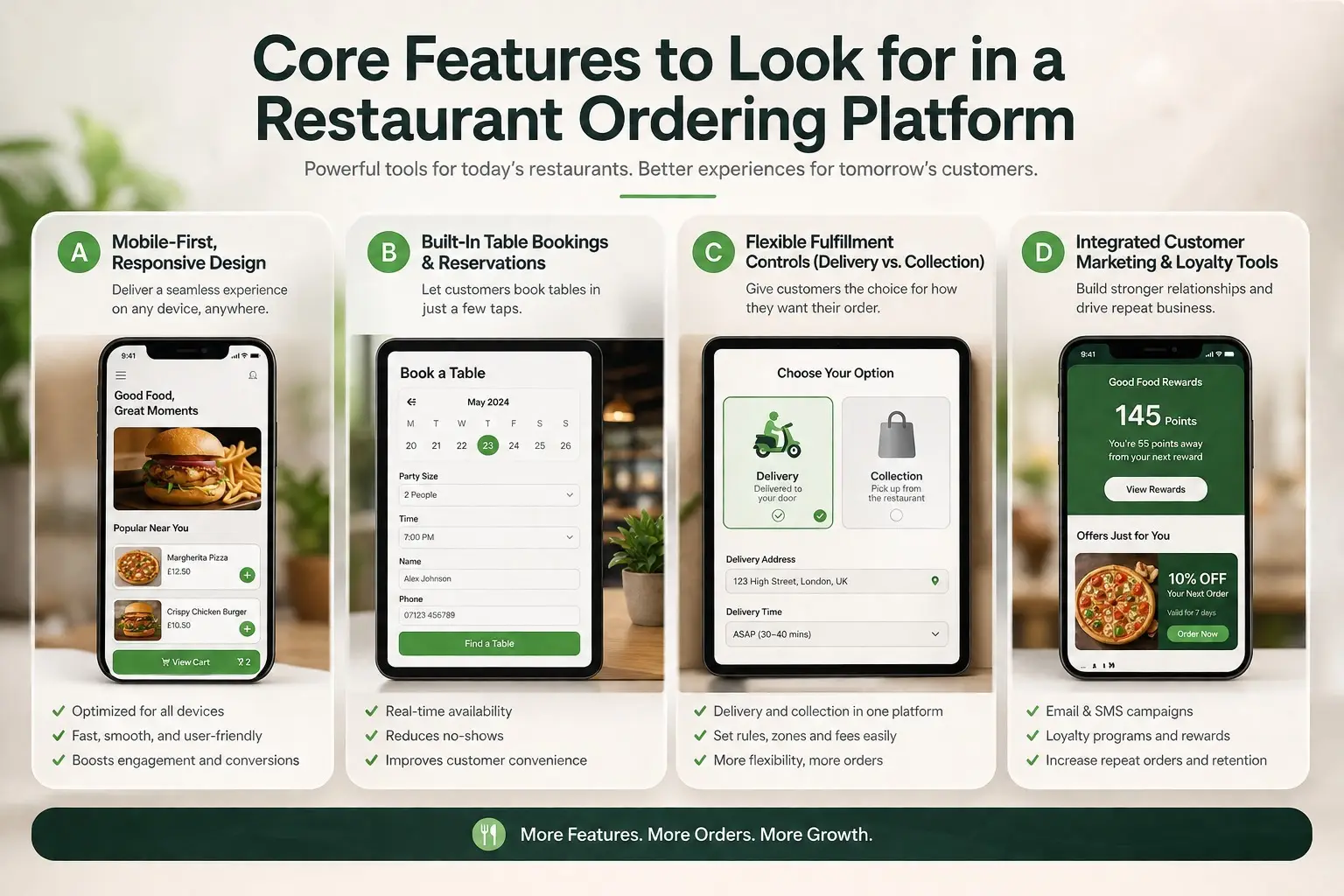
Over 70% of food-related searches and ordering actions happen on mobile devices. If your ordering portal requires pinching, zooming, or loading sluggishly, you will experience high cart abandonment rates. Look for a mobile-first design that feels as slick as downloading an app (without forcing the customer to download anything at all).
Food service rarely exists in a vacuum. Many customers want to book a physical table and pre-order drinks, or they might browse your menu while checking your availability. Advanced platforms like TableReady combine online table bookings with ordering capabilities, reducing friction and giving you a holistic view of your guest volume.
Your software should give you complete autonomy over your logistics:
An effective platform shouldn’t just take orders; it should help you generate repeat business. Look for built-in marketing features that allow you to:
If you are looking for a purpose-built solution designed specifically to help UK hospitality businesses scale without bleeding profits to middlemen, TableReady offers an all-in-one ecosystem.
TableReady was engineered to solve the fragmentation that frustrates independent operators. Instead of paying one provider for online ordering, another for table reservations, and a third for waitlist management, TableReady consolidates everything into a single, intuitive dashboard:
A restaurant online ordering system is no longer a luxury reserved exclusively for multinational fast-food chains. For independent restaurants, cafes, pubs, and takeaways across the UK, it is an operational anchor and a vital survival tool.
By cutting out predatory third-party commissions, owning your customer data, and streamlining your kitchen workflows, you can protect your margins and build a resilient, future-proof food business.
Ready to stop losing revenue to marketplace middlemen and take total control of your digital storefront? Explore how TableReady can transform your restaurant operations with zero-commission ordering, smart bookings, and powerful growth tools today.
How long does it take to set up a restaurant online ordering system?
With modern platforms like TableReady, the technical heavy lifting is handled for you. Menu migration, website configuration, and payment gateway setup can often be completed, tested, and pushed live within just a few hours.
Will I need special hardware to run an online ordering system?
No. Most contemporary restaurant software operates in the cloud. You can manage incoming orders using an existing tablet (iPad or Android), a smartphone, or a desktop computer at the host stand or kitchen pass.
How do online ordering systems handle payments?
Payments are processed securely online through integrated payment processors (such as Stripe or specialized merchant accounts). Funds are automatically processed, transactions are recorded in your dashboard, and payouts are deposited directly into your business bank account.
Can I run both delivery and collection (takeaway) from the same system?
Yes. A robust system allows you to toggle fulfillment options easily. Customers can choose whether they want to swing by for Click & Collect or have their meal delivered to their doorstep, with separate rules and timing buffers for each.

Thank you for your message. It has been sent.